
A growing wave of state laws is telling merchants that “digital-first” and “cashless” aren’t the same thing.
Walk into a bodega in Buffalo and try to pay for your sandwich with a $20 bill. A few years ago, plenty of stores, avoiding the headaches and hygiene of cash payment, might have pointed you toward the card reader instead. As of March 2026, doing that in New York is against the law.
New York’s new cash acceptance law requires most food stores and retail establishments statewide to accept cash for in-person purchases, and bars them from charging cash customers more than anyone else. Violate it, and you’re looking at civil penalties of up to $1,000 for a first offense and $1,500 for every one after that.
That might sound like a step backward for an industry that generally pushes merchants toward faster, more automated checkout. We see it as more of a correction. As we flagged in our 2026 regulatory outlook, federal enforcement has gone quiet in a lot of areas, and states have been filling the vacuum. Like other regulations, cash acceptance is more about maintaining equal access for all customers, rather than trying to turn back the clock.
Here’s what’s driving the cash acceptance wave, why it’s picking up steam right now, and what it actually means for how you run a checkout counter in 2026.
Digital-First Checkout Is (Still) the Baseline
Nobody’s arguing that digital payments are slowing down. According to Worldpay’s 2026 Global Payments Report, digital wallets like Apple Pay, Google Pay, and PayPal now account for 56% of global e-commerce transaction value and 33% of in-store spending.
In the US, wallets represent 40% of online transaction value and 17% of point-of-sale value. That in-store share is growing nearly three times faster than overall POS volume. Every year, payments become a more digital experience.
Over the years, we’ve covered different aspects of that shift, from dynamic routing and fraud detection to agentic commerce, where AI agents are starting to make purchases on a human’s behalf. The infrastructure behind checkout keeps getting faster and more digitized; merchants shouldn’t expect that trend to reverse.
But there’s a second half to that story that gets a lot less airtime: not everyone is along for the ride, and lawmakers have started to notice.
…But Cash (Still) Ain’t Dead
Despite years of “cash is dying” headlines, the data doesn’t back it up. According to the Federal Reserve’s 2026 Diary of Consumer Payment Choice, cash was the third-most-used payment instrument for the sixth year running, accounting for roughly 1 in 8 payments. Three out of four consumers carried cash in 2025, averaging $69 on hand, and 80% used cash at least once in the past 30 days. Ninety percent said they plan to keep using it.
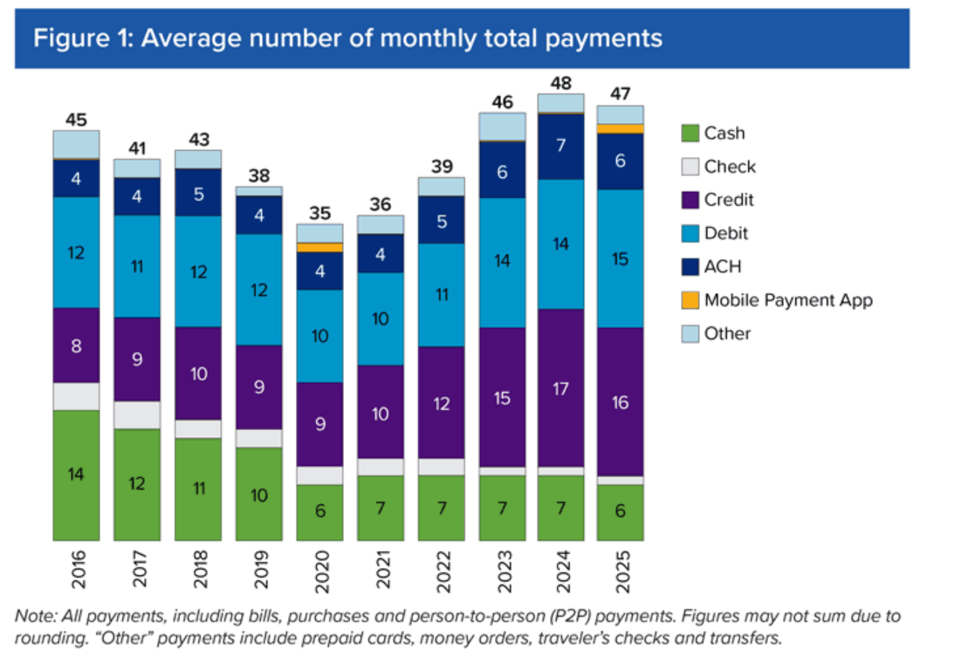
Source: Federal Reserve Survey
Reliance isn’t evenly spread. The lowest-earning households (under $25,000 a year) and senior citizens lean on cash more than other groups. Rural consumers average nine cash payments a month, compared to six for their urban and suburban counterparts. Cash also remains the fallback: when a card gets declined, or an app won’t load, cash can always complete a sale.
That reliance, and the fact that vulnerable groups rely on cash the most, is a big part of what’s driving new regulation to protect cash at checkout.
New York Joins a Growing Patchwork
As states across the country adopt “cashless laws”, we should clarify that nobody’s banning cash or digital payments; they’re banning the refusal of cash. New York isn’t the first to implement such laws, and it likely won’t be the last.
Massachusetts, New Jersey, Colorado, Rhode Island, and Connecticut all have some version of the requirement today, and local laws add Philadelphia, San Francisco, and Washington, D.C. to the map. All told, roughly a dozen states and a handful of major cities now require at least some businesses to take cash.
Maryland could be next. House Bill 191 would require most in-person retailers there to accept cash. At the federal level, momentum is building but hasn’t crossed the finish line.
The Payment Choice Act, reintroduced in the House and Senate in 2025 with two dozen bipartisan cosponsors, would require in-person retail businesses nationwide to accept cash for purchases up to $500 and bar cash surcharges. A single federal standard could simplify life for multi-state merchants (and reseller networks) juggling different rules, but similar bills have failed in the past.
Why Regulators Are Doing This
The logic behind these laws is less about nostalgia for paper money and more about access. According to the FDIC’s most recent survey, 4.2% of US households, about 5.6 million, have no bank account at all, and two-thirds of them rely entirely on cash to get by. Another 14.2%, roughly 19 million households, are considered underbanked. For that slice of the population, “no card, no service” is a lot more than an inconvenience, it locks them out of the economy.
The other argument is about keeping the economy resilient to disasters and other shocks. Digital payments depend on a long chain of things going right at once: power, internet, a functioning POS terminal, and a card network that’s fully online. Cash doesn’t need any of that to complete a sale, which is part of why Australia’s Treasury framed its own mandate explicitly around keeping essentials purchasable when the digital rails fail.
None of that erases the merchant side of the issue. Handling cash isn’t free, between shrinkage, more annoying record-keeping, and higher theft risk. Plenty of businesses went cashless for legitimate operational reasons, and this legislation doesn’t pretend otherwise. It just draws a line: efficiency is the right goal, but it shouldn’t freeze out customers who don’t have another way to pay.
What This Means for Your Checkout
If you operate in, or sell to merchants in, any of the states or cities above, a few things are worth doing now, as a matter of due diligence:
- Map your actual footprint.
Check the rules for every location you operate, not just headquarters. - Kill any cash surcharge.
Wherever cash acceptance is required, charging cash customers more is usually banned right alongside it. Even in states without a formal ban, cash surcharges might expose you to legal and reputational harm. - Don’t restructure around the federal bill yet.
The Payment Choice Act is worth watching, but it’s been reintroduced before without passing. Plan for the patchwork you actually have, not the federal law that would make life simpler. - Build for payment choice, not a binary.
The winning setup isn’t cash versus digital; it’s a POS stack that handles both without friction: cards, wallets, tap-to-pay, and cash, all running through the same system.
COCARD: Built for However Customers Pay
We spend most of this blog on the digital side of payments, because that’s where most of the growth is. That remains the case, but “digital-first” doesn’t mean “digital-only”. Legislation protecting cash, even as customers and merchants move even more payments online, is a reminder that payment choice cuts both ways.
At COCARD, we build POS systems that don’t force merchants to pick a rail. Whether that means adding a compliant cash workflow in a state that requires one, tightening up your digital fraud stack, or just making sure your checkout counter can handle whatever a customer hands over, we’re here to help you get it right.
If you want a partner who can help you navigate the patchwork instead of guessing at it, get in touch today!