
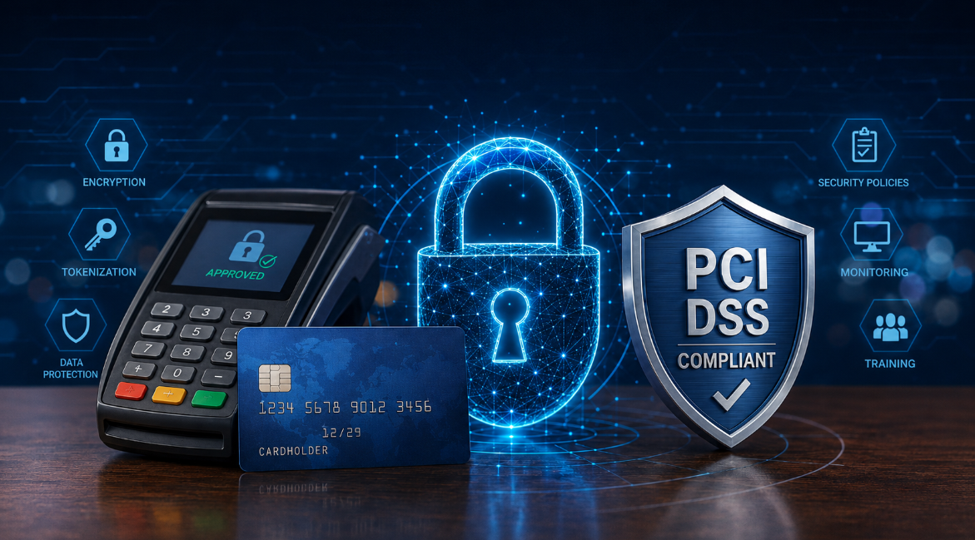
A customer taps their card, the receipt prints, and the line moves. Nobody thinks twice about it. But behind that five-second transaction, the card number passes through a terminal, a POS system, a gateway, a processor, some logs, maybe a backup file. Every handoff is a place that data might be protected, stored, or exposed.
For a merchant, none of that is visible day to day. But a single gap in that chain is exactly what turns into a breach headline, a fine, or a rejected insurance claim.
Encryption is supposed to guard those handoffs, but encryption alone isn’t PCI compliance, and treating it like the finish line is exactly how merchants end up out of compliance, or worse, dealing with a breach. PCI DSS is the actual framework for protecting payment data: encryption, yes, but also access controls, monitoring, employee training, and vendor oversight.
Encryption is the lock on the door. PCI compliance is making sure the whole building is secure: who’s holding keys, which doors got propped open, and whether anyone’s checked the basement lately.
Some of what we’ll cover is technical, but here’s the part worth remembering: most of this shouldn’t just land on the merchant’s shoulders. A processor worth keeping is already doing a lot of the compliance legwork. Knowing what that should actually look like is what protects merchants and their customers.
Let’s dive into five things that matter most.
1. Keep Less Card Data in the First Place
The safest card data is data you never kept. Map where card numbers enter your business (POS systems, CRM fields, handwritten forms, that one email a customer sent with their number in the body) and cut what you don’t need.
Tokenization helps here. It swaps the real card number for a stand-in that still supports refunds and recurring billing, without the original number ever touching your everyday systems. Ask whether your processor is already doing this for you; most modern platforms should tokenize by default, not sell it as an upgrade.
One rule has no exceptions: CVV and CVC codes can never be stored after authorization, encrypted or not.
2. Encrypt From the Moment Card Data Shows Up
Encryption only works if it starts the second a card is swiped, tapped, or typed in. For in-person sales, that means a PCI-listed point-to-point encryption solution keeping the number unreadable from the terminal onward. For online sales, it means that same discipline applied to checkout.
This one is squarely a processor’s job, not something a merchant should have to engineer themselves. If yours can’t confirm the solution is actually on the PCI-listed roster and not just “encrypted,” that’s worth a direct question. Get this piece right, and a lot of PCI compliance gets easier by default.
3. Guard the Keys Like the Data Depends on It
An encryption key stored on the same server as the data it protects isn’t really protecting anything. Good key management means limiting who can access keys, rotating them on a schedule, and logging every use.
Merchants don’t need to become cryptographers, and probably shouldn’t try. This is infrastructure work that belongs with your processor, not your front desk or IT guy. If nobody at your business can answer “who controls our encryption keys,” that’s a question for your payment provider. If your payment provider has no idea, then we need to talk.
4. Know Where Card Data Actually Lives
Card numbers turn up in more places than the main database: logs, screenshots, support tickets, an email nobody should have sent in the first place. PCI scope follows the data wherever it goes, and it needs to be reconfirmed at least once a year, especially after adding a new POS integration or loyalty app.
Outsourcing processing helps, but it doesn’t erase your responsibility. If payment security isn’t the main focus of your business (it usually isn’t), then make sure it’s the main focus of your processor.
5. Treat Compliance as a Habit, Not an Annual Form
Too many businesses treat PCI compliance like a tax filing: fill it out once, file it away, forget it. Security doesn’t run on that calendar. Software changes, employees turn over, certificates expire, and the threat environment never stops changing.
Payment security is a routine, not a once-a-year scramble: patching, access reviews, training, ongoing vendor checks. A processor worth its fee should be running a lot of that routine for you, not handing you a checklist once a year and moving on to the next merchant.
What This Actually Means for Merchants
None of this requires a merchant to become a security expert. What it requires is knowing enough to ask the right questions, and choosing a processor who treats the answers as core to the relationship rather than a line item.
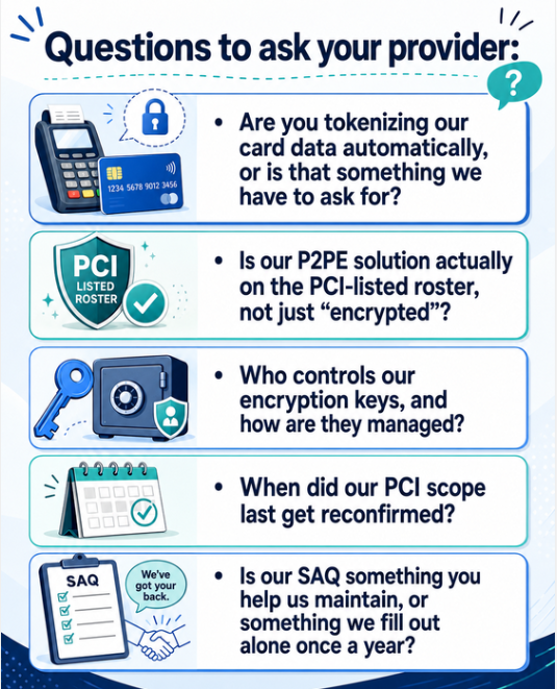
Regardless of where your PCI program stands today, a few questions are worth putting to whoever processes your payments.
- Are you tokenizing our card data automatically, or is that something we have to ask for?
- Is our P2PE solution actually on the PCI-listed roster, not just “encrypted”?
- Who controls our encryption keys, and how are they managed?
- When did our PCI scope last get reconfirmed?
COCARD: Security Built Into the Payment Stack
Decades in this industry have taught us that secure infrastructure starts long before a transaction is processed. That’s why COCARD leads with a PCI compliance program built to handle the legwork, vulnerability scanning where it applies, tailored security policies, employee training, and hands-on help when something needs fixing.
Encryption and compliance shouldn’t be things a merchant has to figure out alone. Whether you’re replacing a terminal, adding e-commerce or new POS solutions, or just taking a hard look at your existing stack, COCARD is here to help. Our job is to handle the parts of payment security that shouldn’t be on a merchant’s plate in the first place.
If you’re ready for an elite, secure, and compliant payment suite, get in touch today.