
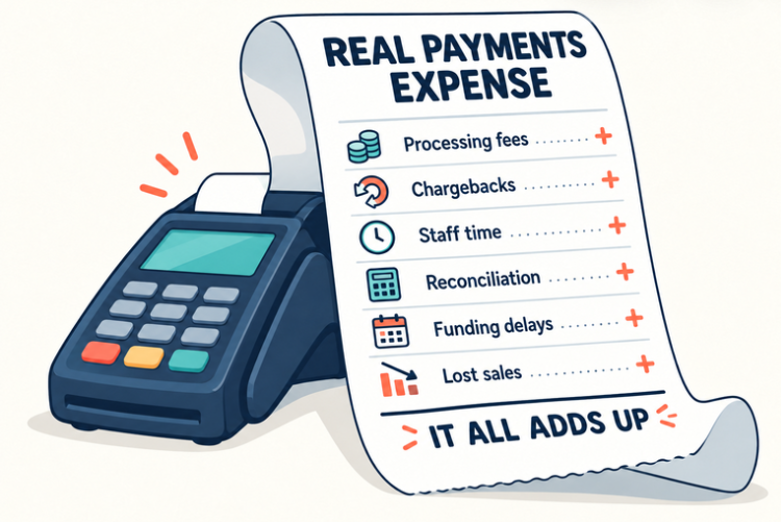
The store closed almost an hour ago, but you’re still at the computer. Today’s card sales don’t quite match the bank deposit. An online order needs a refund, and a customer has disputed a charge that you now have to track down.
When you signed your business up with a new payment provider, that amazing processing rate conveniently left out the cost of all this extra work.
Merchants are smart to seek lower payment fees. Small differences add up when almost every sale incurs a fee. But the total cost of getting paid also includes the hours spent managing transactions, losses from disputes, and sales that never make it through checkout.
As we’ve discussed in past articles, payment systems increasingly connect to everything from customer service to accounting. That makes the cheapest advertised rate a starting point for comparison, but not a full picture. Let’s look at five places where the rest of the bill can hide.
1) Time After the Sale
A payment isn’t finished just because the terminal says Approved. Someone still needs to match it to an invoice, account for fees, and confirm that the money arrived.
When payments and accounting systems don’t communicate, employees (and owners) have to work extra hours connecting the dots. That means downloading reports, reentering amounts, and investigating differences between sales totals and deposits. Refunds and transactions spanning different reporting periods can make that work harder.
Consider a business processing $50,000 monthly. A rate reduction of 0.20 percentage points saves $100 a month. Meanwhile, 45 minutes of manual reconciliation across 20 working days adds up to 15 hours. At $25 an hour, that’s $375 in staff time.
The owner might step in, but that time has value even when it doesn’t hit payroll. Ask your provider to demonstrate how a sale becomes a bank deposit and an accounting entry. Make sure they include a refund scenario; that’s a major source of extra work.
2) Chargeback Challenge
A chargeback can cost more than the payment being reversed. There may be a dispute fee, lost merchandise, or employee time spent assembling evidence. Even a successful defense still takes work.
Funds generally remain unavailable while the case proceeds. A full dispute lifecycle can take two to three months. Check your own provider’s response deadlines, fees, and process for returning funds after a win.
Start prevention with the easy issues to avoid. Make sure customers recognize the business name on their statements. Explain refund and cancellation policies before purchase, provide receipts, and make it easy to reach someone about a billing problem.
Keep delivery confirmations and relevant customer communications accessible. Your provider should explain how to retrieve transaction records and respond to a dispute.
3) The Price of Slow
A Friday sale and money available for next week’s payroll are two different things. Funding schedules, cutoff times, weekends, and account holds can affect when merchants can actually use their proceeds.
Delayed funds aren’t automatically a loss. The cost comes if the delay forces the business to borrow, postpone an inventory purchase, or keep a larger cash cushion.
Ask your provider to explain the funding timeline for your account, including exceptions. Confirm when money becomes available at the bank, rather than relying on a label like “daily payouts.”
For invoice-based businesses, also look at the days before a customer pays. A payment link or a well-timed reminder may help shorten that wait. Measure the result against your existing collection process, including the time employees spend following up on overdue invoices.
4) The Customers Who Never Were
Some payment costs don’t appear on a statement because the transaction never happens.
Losing Sales to POS Friction
Source: Baymard Institute
Baymard Institute’s checkout research reports that 17% of U.S. online shoppers have abandoned an order because checkout was too long or complicated. Nearly 20% of cart ditchers cited reluctance to give their card info due to lack of trust.
This doesn’t mean simplifying and securing checkout will recover 40% of your lost sales, but it shows how the payment experience can lose customers who were close to buying.
Walk through your own checkout on a phone. Can customers pay without creating an account? Can customers choose reputable payment platforms? Are prices and available payment methods clear? What can a customer do after a card gets declined?
For in-person businesses, watch what happens during a rush or when a terminal loses its connection. Ask your provider about suitable backup options.
5) Estimating the Real Number
The rate on a proposal may sit alongside transaction charges, software subscriptions, gateway fees, equipment costs, and optional services. Some charges depend on how the business accepts payments or which features it uses.
Request a written estimate based on your actual sales volume, average ticket, and mix of online and in-person transactions. Ask what happens to fees when you refund a sale, and review equipment leases and cancellation terms before signing.
For a quick baseline, divide your total monthly processing charges by the card volume processed that month. That gives you an effective rate to compare across similar months. Keep labor and lost sales separate so you can see what each improvement actually changes.
COCARD: Helping You Count (and Cut) Costs
Since our founding in 1999, COCARD has committed to maximizing value for our merchants. Although our processing fees are highly competitive, the difference is in the costs we cut and the sales we save through streamlined, industry-leading service.
COCARD helps merchants explore processing and POS solutions around the way they do business. We can help you ask how the proposed system handles everyday transactions, connects to your operation, and supports your staff when something goes wrong. More importantly, we’ll help you assess the total cost of your POS system, not a marketing number.
Get in touch today to explore a payment suite that makes it easy.